


ast week the Federal Reserve cut rates for the second time this year. The new, lower trading range for short rates is now 3.75% to 4.0%. The Fed also announced an end to its quantitative tightening program. This means that the Fed will no longer sell off the assets it holds on its balance sheet. Maintaining these assets on the Fed’s balance sheet provides more liquidity to financial markets, as the Fed will no longer drain these assets through asset sales.
The big question facing financial markets is when will the Fed cut rates again? Fed Chairman Jerome Powell stated in his prepared remarks on Wednesday that a December move to lower rates was “far from certain.” Powell’s cautious remarks regarding a potential December move were possibly prompted by divisions within the Fed.
Recent appointee Stephen Miran voted to lower rates in November by 50 basis points instead of the 25 basis point move the Fed enacted. The President of the Kansas City Federal Reserve Bank, Jeffrey Schmid, voted to leave interest rates where they were at 4.0% to 4.25%. This is the first time the Fed has had two of its members disagree in more the 6 years. Powell’s cautious comments regarding future Fed policy undoubtedly reflect this split among voting members of theFed.
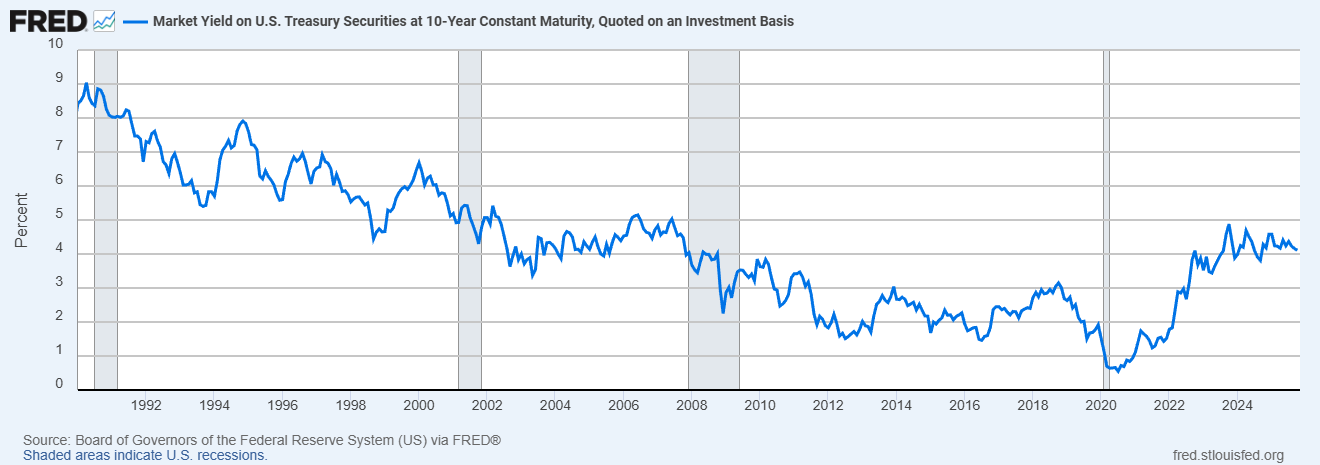
Uncertainty over future Fed moves has impacted financial markets. The 10-year treasury would normally be expected to fall along with the short rates that the Fed directly controls, but since the Fed meeting the 10-year has bounced nearly 15 basis points to 4.08%.
Determining Fed policy is even more difficult at this point than it normally is. The one economic statistic that made its way through the US government shut down was CPI. CPI posted in September a 3.0% 12-month rate of increase. That was slightly below expectations of 3.1% but remains well above the Fed’s target of 2.0%.
Normally the Fed would not be considering a cut in rates with CPI so far above its target. However, the Trump administration moves to restrict labor markets through curtailing illegal immigration have had a definitive impact on job gains in 2025. In addition, the trade war with China and other members of the world economy have the potential to slow down consumer spending.
The combined effect of the immigration restrictions and trade war place a big question mark on future economic growth and could call for more aggressive Fed action. On the other hand, slowing payroll growth could be the normal reaction to the big swing in illegal immigration, and the trade war has not yet had a major impact of consumer spending. These uncertainties are the reason for the divisions on the Federal Reserve board and the uncertainty in financial markets over future Fed moves.
Our response to the uncertainty and fluctuating impulses impacting the Fed is to stick with our current strategy. We have already reduced our overall risk exposure and increased our weighting to low volatility and dividend weighted equities. We are not sure when the excesses of the current market will be made clear for everyone, but we are sure that moment is in the not-too-distant future. We will keep dry powder for when that risk off moment arrives.


