

resident Trump has introduced tariffs on the world of trade. He first introduced tariffs in early February starting with Mexico, Canada, and China. The weeks and months since these initial tariffs have seen Trump impose tariffs across the globe, impacting virtually every country in the global economy. President Trump has also entered into trade agreements with the UK, Japan, South Korea, the Eurozone, and a dozen or more nations across the globe. These nations have largely agreed to pay Trump’s minimum tariff ranging from 10% - 15%.
China, Mexico, Canada and India have thus far been left without a clear path forward. China has innumerable ways to retaliate against the US, including withholding exports of critical rare earth elements. China and the US will find a way to work out their differences. Mexico has made significant progress toward making a trade deal and should also be in similar shape as early tariff adopters when their final trade deal is reached.
Canada and India are in very different circumstances. President Trump’s treatment of Canada as a 51st state has offended Canadian officials, making it more difficult for the newly formed leadership to agree to the concessions demanded by his administration. India has a long history of high tariffs on its domestic production. That history makes caving to President Trump’s demands as difficult to President Modi as to Canadian Prime Minister Carney.
The purpose of President Trump’s tariffs is to bring manufacturing back to the US and early signs are encouraging for the Trump administration. US growth in the second quarter came back from a decline of -0.5% in the first quarter to a robust 3.0%. Growth was spurred by a significant drop in imports.
Perhaps the most surprising part of Q2 GDP was the drop in inflation from 3.8% in Q1 to 2.0% for Q2. Inflation is supposed to be the hot button issue if the world is going to devolve into a trade war. The sharp drop in the rate of inflation was a surprising bit of great news considering President Trump’s global tariff war.
On the other hand, all is not well in the US economic data. US employers added a mere 73,000 jobs in July, and revisions to May and June data dropped job gains in those months to less than 100,000. The economy shed 11,000 manufacturing jobs in July, following losses of 26,000 in May and June. Trump reacted to this bad news by firing the head of the Bureau of Labor Statistics.
Perhaps the best way to determine who is winning or losing the trade war is to look at financial markets rather than economic statistics. The chart below shows performance of the S&P 500 over the past 55 years. We compare the short-term performance of the S&P 500 to its long-term trend return.
The long-term trend of the S&P been a steady 6.73% over inflation for more than55 years, while it’s shorter term 1-year returns have varied from -40% to more than +60%. This huge variation in returns is a function of market circumstances and valuations at various points in the market cycle.
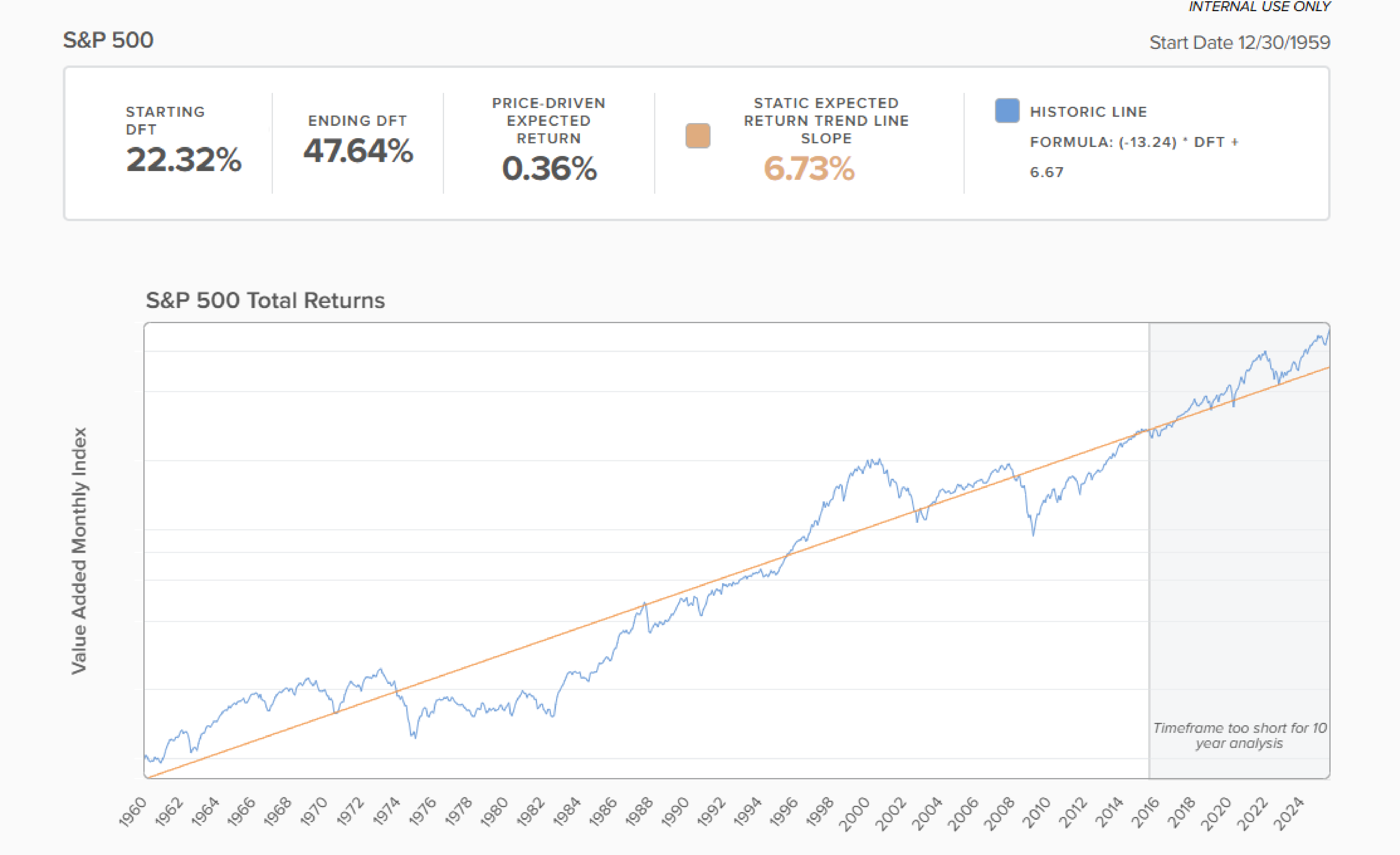
There have been 3 extended periods of above average trend returns; the 1960s, the1990s, and the current period. During these extended periods of overvaluation, the S&P produced double digit returns getting to that overvalued state but then dropped off to slightly below average returns until a big market drop occurred.
We have not hit such a revaluation point in the current market cycle. That may mean that we will defy history and keep marching higher, or it may mean that markets take a sharp downturn somewhere in the future.
Given that historical periods of excess valuation continued for more than 10 years in the 1960s, we cannot say that the current ride is over. What we can say is that we have reached the point of the S&P 500 where returns in the best case have dropped historically into the 5% range.
Considering the limited upside to potential for the S&P 500 and the potential for a big downside revaluation, we believe that investors should lower their weighting to the S&P 500. In our next Strategic Insights, we will examine different strategies investors can explore to lower their large cap US stock weightings without lowering their overall equity weighting, and more aggressive derisking strategies that will reduce overall portfolio risk.


