President Donald Trump received a shocking rebuke from voters as Democrats swept to election victories across the nation. Democrats won from Maine to Texas, reasserting control over the House of Representatives (as expected) but also won control of the Senate. Final tallies in Alaska are still being compiled, but Democrats have won at least 258 seats in the House and 56 seats in the Senate. Democrats won in several unexpected places, including Texas, Kansas, South Carolina and Mississippi (yes, Mississippi).
President Trump has not responded to the Democratic wave with substantial personnel changes in his cabinet. His only move thus far has been to replace his Chief of Staff, Susie Wiles, with Stephen Miller. Miller has been the architect of President Trump’s aggressive ICE crackdown on illegal immigration. His elevation to Chief of Staff could be a sign that the Trump administration is not looking to build bridges to the incoming Democratic leadership.
Markets have been fairly volatile since the election, rising or falling almost every day. From our perspective, the results of the election are as follows:
1. The end of the Artificial Intelligence bubble. US voters sent a strong anti-AI message last Tuesday. Many anti-AI ballot measures were passed and the overall election tone had a decidedly anti-tech and data centers feel to it. This turn against AI may receive broader support with the end of the week resignation of Nvidia’s Chief Executive Officer Jensen Huang. Huang has admitted to an affair with Alice Huang (no relation to Jensen Huang), and Ms. Huang is suspected of being tied to Chinese intelligence. In addition, Mr. Huang has been accused of two other affairs with Nvidia employees. Nvidia is the leader of the global AI space and Huang has been instrumental in shaping US policy toward China. The combination of bad election outcomes and bad decisions from the leader of the AI industry will put downward pressure on overvalued AI shares, especially after Democrats assume power at the turn of the year.
2. Unwinding the AI bubble will put downward pressure across the stock market. The AI bubble has been fueling growth across the economy. Nvidia’s announcement of a potential stock buyback could disrupt Nvidia’s bankrolling of endless AI investment. Any disruption in the AI market will have broader economic consequences.
3. The negatives from AI may be partly offset by a reduction in trade frictions. Democrats have traditionally been less supportive of trade than Republicans, but the Trump administration’s aggressive trade war against traditional allies like Canada and France have opened the door for more support from Democrats. Both House and Senate incoming Democratic leadership have identified the trade war as a source of escalating costs for consumers. Although resisting a call for a return to a more free trade approach, the broad brush applied by President Trump across a wide swath of America’s allies will be resisted in the new Congress. Trade tensions could ease as a result.
4. Oil should continue to decline. Oil peaked before the election and has been on a downward path ever since, dropping from $104 per barrel to $86. A potential global supply glut weighs on market sentiment. If we are correct and oil prices continue to slip, lower prices at the pump could eventually improve consumer sentiment.
5. The 10-Year Treasuries should be capped close to current levels. The past 6 months have seen a substantial advance in Treasury yields, from about 4.5% to a peak of 5.3% and now about 5.12%. We think the cumulative effect of rising rates, higher gas prices and a potential unwinding of the AI bubble will eventually put a cap on yields somewhere near current levels. As we move into 2027, the cumulative impact of the tightening in Fed policy and the potential bursting of the AI bubble should slow economic growth enough to cause the yield curve to invert as long rates come down appreciatively.
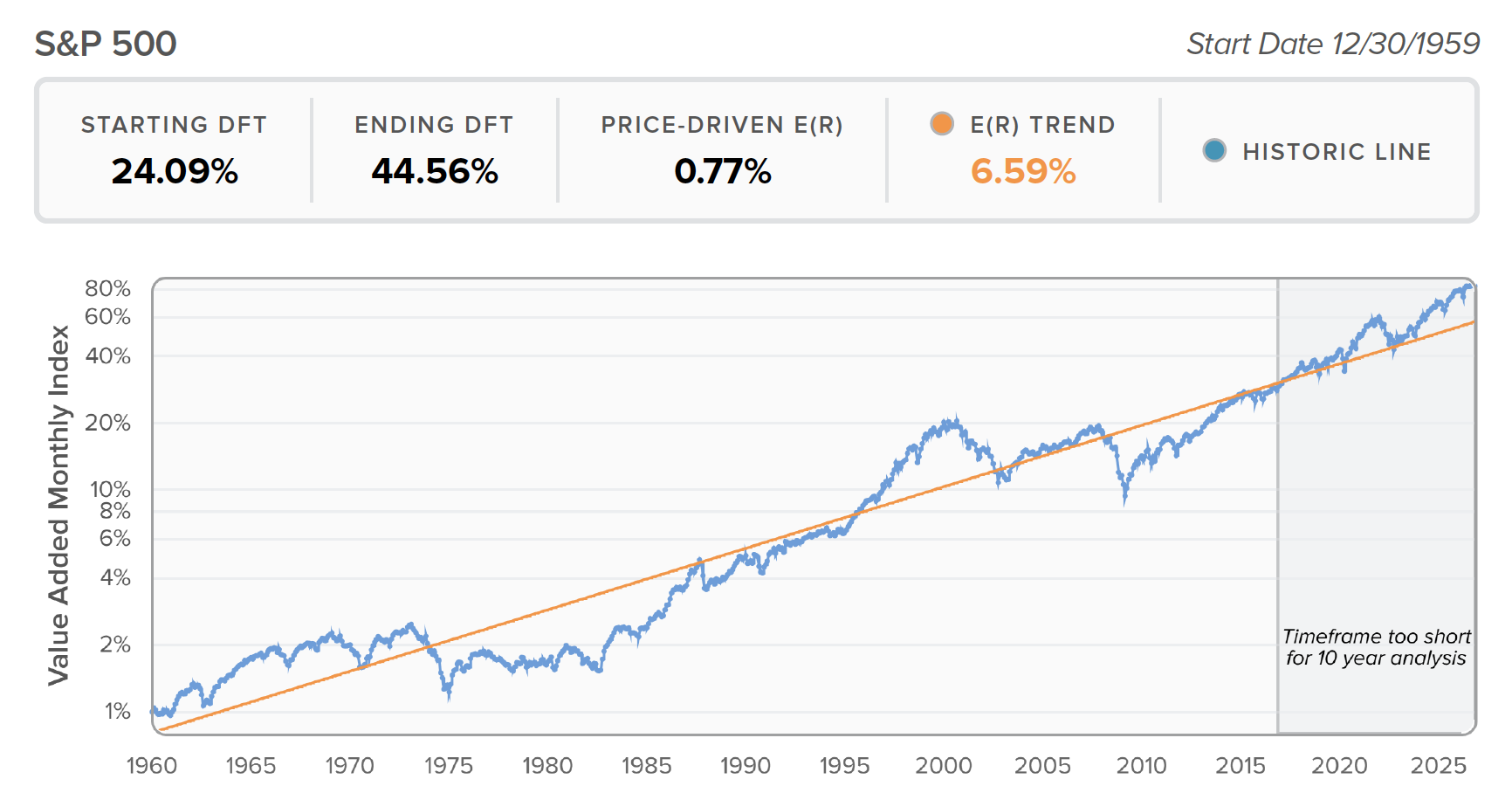
We feel that election results will put downward pressure on equity markets. Equity valuations are already stretched to historically high levels, and the unexpected Democratic sweep provides a catalyst to return markets to more normal levels. Over the next year we could see a reduction of more than 20% in equity prices. That would keep equities in the overvalued range but would be much closer to long term equilibrium levels. If markets continue to downplay the forces pushing prices toward more sustainable levels, it will be setting the stage for a more severe market downturn in the future.
As shown in the chart below, the S&P 500 is showing an overvaluation of 45% over its long term return. Based on that overvaluation, our models are projecting a long term real return of .77% over the next 10 years.